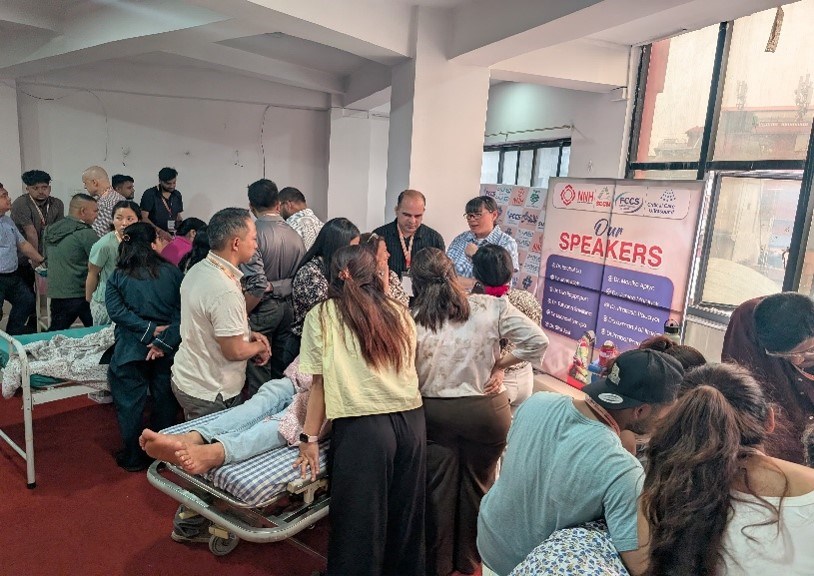
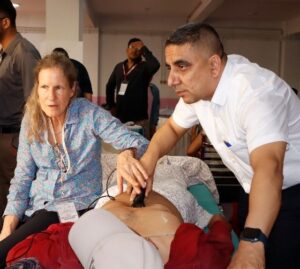
In April, Dr. Monika Aplyn and a team of US- and Nepal-based faculty traveled to Kathmandu to teach a two-day critical care ultrasound course at Nepal National Hospital. Thirty-four physicians and trainees from hospitals across Kathmandu and Pokhara learned how to use point-of-care ultrasound (POCUS) to diagnose conditions like heart dysfunction, collapsed lung, and blood clots in real time, at the bedside. The course itself was intensive: two nine-hour days mixing short lectures with hands-on practice. Dr. Aplyn’s team brought seven ultrasound machines with them, several on loan.
Trips like this take a lot to pull off, and they aren’t cheap. That’s where the CHG Healthcare Foundation came in. A portion of Dr. Aplyn’s trip was funded by the CHG Healthcare’s Individual Provider Grant Program, which supports medical providers who want to give back to communities through medical mission trips. She first heard about the program from a colleague who had received a grant for a mission trip of their own.
Removing barriers to giving back
Beyond her colleague’s recommendation, Dr. Aplyn applied because the Foundation made the process easy. “There’s so much you have to do to prepare for a trip like this that it’s often beyond the bandwidth of most of our instructors to even think of seeking out financial aid,” she says. The grant covered training materials and other program expenses, support she called invaluable. Without it, courses like this one are much harder to get off the ground, not for lack of will, but because the volunteer physicians who teach them rarely have time to also chase down funding. That’s the quiet, practical impact of the Foundation’s support. It helps clear some of the administrative and financial hurdles so providers can spend their limited time where it matters most.
What the impact looks like on the ground
For Dr. Aplyn, the impact showed up in a specific way: questions. “There were countless moments when we got questions and questions and questions,” she says, describing learners who wanted to take ownership of their own results. She sees that as the only way ultrasound training actually sticks. Providers have to feel responsible for building the skill themselves, not just watching someone else use it.
The stakes are real. Ultrasound is a relatively low-cost tool that can diagnose a wide range of conditions, and it’s especially valuable in resource-limited settings where CT scans and echocardiograms aren’t always accessible. For Dr. Aplyn, seeing grateful learners ready to take what they’d learned and run with it was one of the most rewarding parts of the trip.
Building something that outlasts one trip
This was Dr. Aplyn’s second time teaching this course, and she’s already thinking about what comes next — training Nepalese physicians to become instructors themselves and building a program that can sustain itself. That’s the kind of long-term impact the Foundation’s provider grants are built for. It’s not just funding a single trip. It’s funding the groundwork for something that keeps growing long after the visiting team goes home.
If you’re a licensed healthcare professional interested in joining a medical mission trip, search trips from our partner organizations, or apply for an Individual Provider Grant.